Saturday, May 18, 2013

We're not in Kansas anymore, Dorothy...


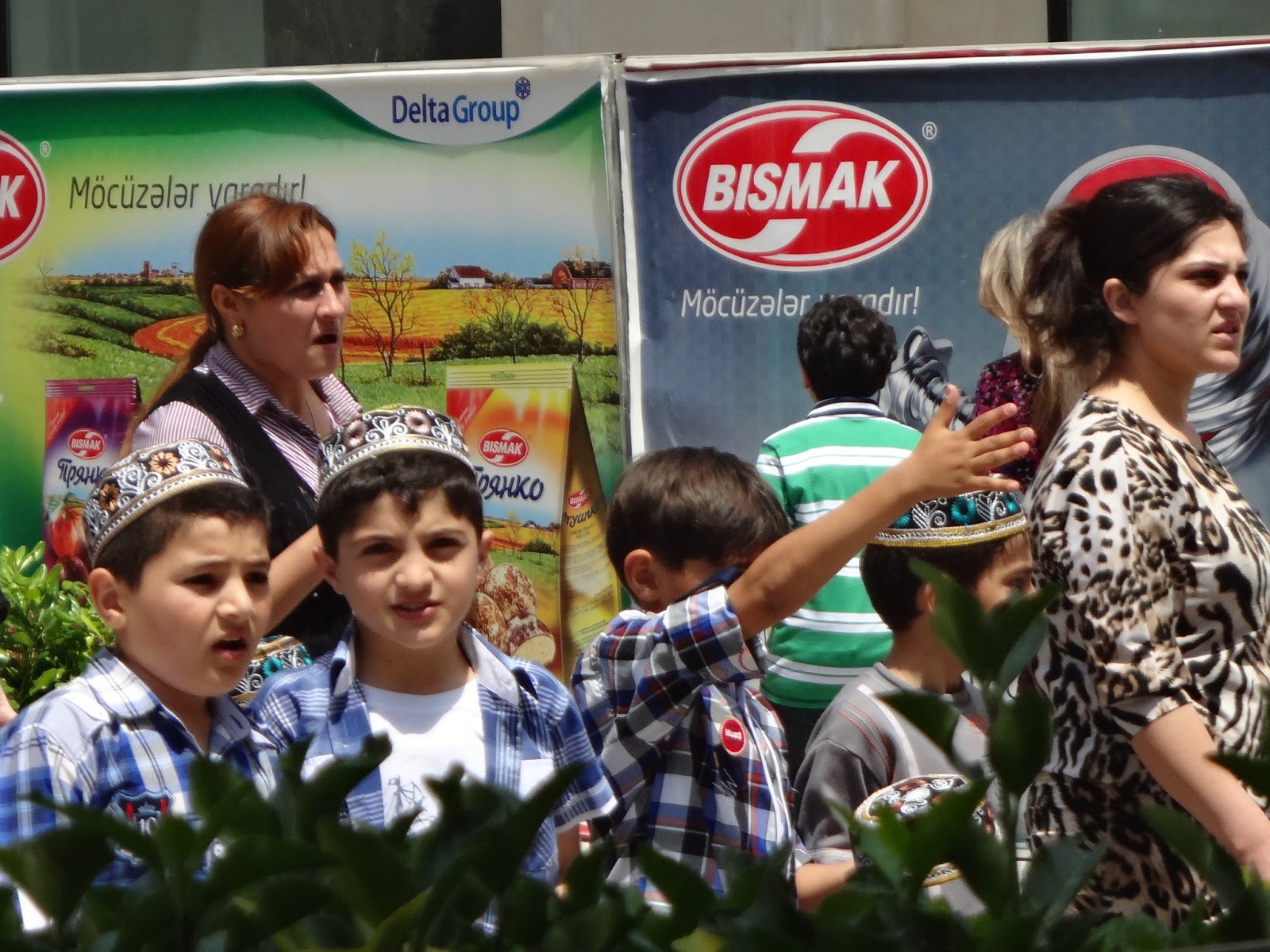
Wow... I am struggling to claim words to describe this place to which we have come... Baku... in Azerbaijan, on the western shore of the Caspian Sea. We came here to see the country of our son-in-law, to meet his family, to honor Katie and Elnur's life together, to experience someplace so different from anything we have ever experienced. And, although we have been here only a day and a half, and most of that comatose from a day and a night of travel, we are finding it difficult to take it all in. When I say "we", I mean all of us; Kate, Elnur, Ryan, Kristen, Connie and me. It's a family affair.


We flew out of Jacksonville Florida on Wednesday, joined up with Kate and Elnur in DC and flew out of Dulles on Thursday. The pups are happily holding down the fort on Saint Simons Island with Mary Helen and Beth providing joint custody with visitation rights. And Momo is visiting Aunt Jordan and Uncle Devon in Arlington.
 
We rendezvoused with Ryan and Kristen at Heathrow Airport in London and after a 3 hour layover embarked on a 6 hour flight to Baku. We arrived at 7:30 PM and were warmly met by Elnur's father, Ilgar, his Uncl, Zamir and Ilgar's good friend Nadir.

We are staying at the Amber Hotel, just a 10 minute walk from downtown. The views from our balcony (s... we have 3!) are spectacular. Azerbaijan is an oil country. In the 1930 and 40s  they produced 50% of the world's petroleum and, though less prominent now with the development of other international global reserves, they are still very much in the energy business. The architecture reflects it, reminding me of pictures I have seen of Dubai. Azerbaijan was one of the 16 Soviet Union republics until their independence in 1991 and there is also a strong remaining Soviet Union architectural  and historic presence.

Azerbaijan is a secular country and has strong Muslin roots. Some of the women on the streets wore head scarves. Most did not. The fashion is very European. Restaurants are plentiful as are the shops; clothing, jewelry, shoes, liquor, internet cafes, coffee shops... everything you would find in any other large (4 million people) metropolitan city.

Some of our family and friends expressed concern for us going on this visit. The media and the government have fanned the flames of fear and prejudice. We are fed a constant diet of division and divisiveness. It's so difficult to find the truth and we don't claim to know it, but painting everyone with one brush is never true. I'm just saying...


After 10 hours of much needed sleep (for those who could. Jet lag hammered Coucou and Kate) and after a great buffet breakfast of eggs, sausage (turkey), tomatoes, cucumbers, fried eggplant, olives and some fantastic bread, we walked downtown.


After a nap, we gathered for a cab ride to Ilgar's home where we were introduced to some of the most wonderful people you'll ever meet. If you have met Elnur you'll understand when I say "the apple don't fall far from the tree." The 86 year old grandfather, Elnur's sisters, uncles, aunts, cousins, nieces nephews. It was a such a wonderful opportunity to meet everyone. And the traditional, delicious Azeri meal they presented was beyond description.


Poor Elnur talked himself hoarse with everyone competing for his translating abilities.  It was so heartwarming to see how much Katie was loved and accepted by her new family. We are very grateful and proud to be a part of this wonderful extended family.
 
End of Day 1. Can't begin to imagine what will come tomorrow.
 
Stay tuned...
 

Saturday, May 11, 2013

Lessons You Learn

The overweight 60ish woman in spandex had  parked her car in the middle of the driveway between the two banks of storage units off Route 17 in Brunswick, Georgia and she had left the driver's side door wide open, preventing any other vehicle from accessing the facility. I pulled up behind her vehicle and patiently waited for a glimmer of self awareness as she scurried between her car and the locked storage unit and her cell phone. She was entirely unaware of anything or anyone, but her own situation. Like a squirrel in an oak grove. Odd.

She drove a late model, gray sedan with Texas plates and her hair was an alarming two tone combination, silver gray roots and an distinct, overripe eggplant purple color dye job on top. pulled up into a Pebble's Ponytail. You know, right straight off the top of her head like a palm tree.

After a few minutes, I pulled along the driver's side and rolled down my passenger side window.

"Hey, excuse me, but would you close your door so I can get by?" I yelled at the distracted woman.

"OH! OH! Yes, I will. I'm sorry, I didn't know I had left it open. I'm sorry. I'm sorry." she whined as she shuffled to the driver's side of the car to shut the door.

"No problem." I muttered as I squeezed past her car. " Stupid woman! Stupid Texan!" I railed as I parked the van. Who in hell did she think she was inconveniencing me like that. I felt strong, wronged and righteous.

Ah, the ugly ego reared it's grotesque head. At least now, I recognize it, and checked the mindless, self centered arrogance sooner, rather than later. Still, it troubles me that I must continue to fight this distasteful demon.

I unloaded my vehicle and secured my stuff in Mary Helen's storage unit. It took me about ten minutes and when I attempted to leave the facility, there she was again, standing in the middle of my exit lane. WTF!

She walked directly at me. "Do you know how to cut off a lock? I broke my key off in the lock. They told me it's going to cost $50 to cut it off. My husband just lost his job. We have to move back to Texas. I'm thinking about renting one of those Pod units. Do you know anything about Pod units. I see you are from Maine. That's a beautiful state."

"Have you been to Maine?" I asked as she took a breath. The question didn't slow her down one iota.

"Oh no, but that's what I hear. I have relatives in Cape Cod. My husband used to work for Jared's. It just broke off in the lock. I know it's the right lock. I was just here yesterday. Can you help me?"

This poor woman would have so benefited from a double dose of ritalin or xanax. ADD on crack.

I opened the hatch on the van and removed my tools. The woman called someone on her cell phone and was relaying a blow by blow of her ongoing ordeal. After five minutes, I had successfully pushed the broken key into the channel and, using a pair of pliers, forced the broken end of the key into the keyhole and turned the latch. The lock fell off the hasp into my hand.

I turned to face ADD Woman. Her eyes widened and I dropped the broken lock into her outstretched hand. "How did you do that? You saved me a lot of money. I'm going to go in and buy a new lock right now." She turned and bolted for the office. Looking over her shoulder she called "Thank you..."

Somehow my indignant, outrage, being inconvenienced  and put upon day had turned into a feel good, helping someone out, I'm the hero day.

 Guess which one felt better...

Lesson over.

Thursday, May 9, 2013

May 8, 1970


Fogler Library steps at the University of Maine in Orono. That's where I was that late Friday afternoon on that chilly spring day. But, other than the weather, things were very much heated. It was the week of the Kent State shootings in Kent, Ohio where 4 students were killed  and 9 wounded by a nervous squadron of Ohio National Guard troops. The students had been demonstrating against the Cambodian Campaign which president Nixon had announced on April 30, an escalation of the very unpopular Vietnam War.

For years there had been similar anti-war demonstrations on college campuses across the country, but this was the first time demonstrators had been fired upon. Quickly, over 450 universities, colleges, and high schools closed throughout the United States due to a student strike of four million students. Violent and nonviolent demonstrations raged for weeks. 30 ROTC buildings across the country were burned or bombed. And that was the intention of  some of the demonstrators on that chilly day in May on the steps of Fogler Library.

University students were preparing for a final round of prelims and finals later that month. There was confusion and uncertainty. Should we support the strike? Should we go to classes? The faculty and the administration were largely silent, not wishing to fan the flames of dissent. I decided to go to my political science class to hear the debate. The professor sat silently at his desk in a class that was only half in attendance. He glared at the seated students for a few minutes before the leaped from his seat and began to scream.

"WHAT ARE YOU DOING HERE! HAVE YOU NO CONSCIENCE? WHAT OF YOUR FELLOW STUDENTS KILLED AT KENT STATE? GET OUT OF HERE! YOU DISGUST ME!

On to Microbiology... where the professor made it very clear that nonattendance and failure to complete all the course work would result in a failing grade. Confusing.

As I walked back to my dorm, the chanting and shouts from the library steps drew me in. On one side of the steps were a small group of ROTC students in uniform and a larger, well known group of muscled athletes. The ROTC building on campus was attached to the field house and gymnasium at the other end of the quad. Kent State or no Kent State, these vocal students were definitely not in favor of burning the complex on this or any other day. They were threatening physical violence against anyone who might think otherwise.

On the other side of the steps, closer to the Student Union was a large, loud gathering of students, most with long hair and dressed in hippie garb. The leader of this motley and angry group was screaming through a bull horn. He was incensed. I recognized him immediately as the editor of the Campus Student Newspaper. I didn't learn until later that he was also the President of the SDS, Students for a Democratic Society, a radical, left wing organization.

After a long, emotionally heated screaming match, the groups were deadlocked, neither risking the violence which bubbled just beneath the turbulent surface. As the sun went down the Campus Police capitalized on the stalemate. They waded in with their own bull horns and ordered the groups to disperse. And they did. So confusing.

The semester ended early. The University wisely chose to defuse the powder keg by sending everyone home on summer recess. Each person in those turbulent times was left to deal with their individual conscience. Some people burned draft cards. Some participated in candle light marches. Some gave blood to support the troops. We all moved on in our own way, never forgetting the awful loss of life in Vietnam and on the college campuses.

That summer my student deferment ended and I became eligible for the draft. My mother was very nervous and I remember her approaching me at the top of the stairs in our home in South Portland. "If you are called for the draft, you are going to Canada. Do you hear me? You are not going to go to Vietnam!? I didn't know what I would do, but I was spared from that decision. My birthday was drawn number 339. It's the only time I have every won anything in a lottery. It was the only time it really mattered..

 The vocal hippie leader of the anti-war demonstrators went on to graduate that May and to distinguish himself in other ways. He became an author and did quite well for himself, selling over 350 million books. His name... Stephen King.

Well done, Stephen. Guess it beats spending 30 years in jail for arson...


Buck


He was pushing a cart down the canned vegetable aisle of Winn Dixie. It held an assortment of black eyes peas, okra and mustard greens. But what really caught my attention was his WW II Veteran's baseball cap. I caught his eye and he returned my smile.

"I like your hat" I said.

"Well, thank you very much, young fella. Do I know you?" he replied

I said, "No, but I want to know you." He laughed and pushed his cart to the side for a chat.

We shook hands and he said "My name is Buck and I'm 96 years old."

I said "Buck, you're looking pretty good for 96. My name's Glen and I'm from Maine."

"How long have you been on the island?" he asked.

"Around 8 months. How about you?"

"72 years... so far." he chuckled.

"My father-in law was in the Army Air Corp, The Mighty 8th; Chuck Yeager's outfit. He passed away in 2007."

"Well, lawd, lawd, I was in the Army Air Corp, too. I was a medical corpman. Set a lot of broken arms and legs. Lost track of how many. And I worked as a ship builder, too. I tell people you jes gotta keep going, keep working. Cause if you stop and set down, you rust up solid and die. Ain't many of us left. Jes gotta keep on goin.

We talked for another 10 minutes and when it was time to move on he stepped closer and shook my hand with both of his in a warm embrace.

"Nice talking with you, Buck. Thanks for the chat. And thanks for what you did." I fumbled.

"Nice talking with you too, young fella. Jes keep on goin..."

One of the Greatest...

Friday, March 22, 2013

Labor Disputes

I enjoy talking with my cousin. We are the first born sons of sisters and we grew up together, spent a lot of time just being kids. He is 5 months older than me, something he never let me forget. Craig is the closest thing to a brother I will ever have.

After high school we headed in our own separate ways, but we have always stayed close. We both married and raised families in Maine. My career was in the paper industry where I worked in various management positions. His has been on the waterfront where he built his lobster and bait businesses. I had the opportunity to work in his businesses over a couple summers during these past 6 years and really get to see his world. It was an experience I wouldn't trade.

His world is so different from the corporate world from which I came and I stand in awe of his determination, his persistence and the high level of risk he endures in order to succeed. The day to day pressure under which he operates would crush a normal man. But then, Craig has never been normal. He has always been extraordinary.

My position as the HR/Labor Relations guy at a paper mill was also a pressure cooker job. There was a constant stream of disputes, grievances, employee issues with which I dealt on a daily basis. After 23 years, I moved on. Best decision I ever made.

Sometimes, after work on the docks, we would walk down the wharf to the Port Hole for a beer. And we would tell stories. His waterfront stories were always funny and off center. I would respond with mill stories which were also pretty twisted at times. I told of employees shooting deer out the pulp mill window, fights, sexual harassment cases, all manner of employment infractions which I had to resolve. Discipline and discharge were perhaps my least favorite functions. I had been "through the mill", so to speak, and I thought I had heard it all. That was until Craig told me the story of one particular mediation he had conducted.

Craig's business plan is pretty simple. Keep your ears and eyes open. Keep your mouth shut whenever possible. Follow the opportunities. Be honest. Provide the best service and product. Big business spends fortunes on high powered business schools and hires expensive consultants to ingrain these attributes into their corporate cultures, usually with limited success.

And so, when the sea urchin markets began to grow in the 90's, Craig jumped in with both feet. He leased a warehouse and set up cutting houses to harvest the black, oily roe from the spiny echinoderms, about the size of a tennis ball. He opened markets with the Japanese buyers, sourced a supply from the divers and hired a crew of Cambodian workers. Language barriers not withstanding, things were going along pretty well. The money was good and, though he was flying by the seat of his pants, nothing new for him, the business was thriving. That was before his Japanese junior partner back stabbed him, stole his customers and suppliers and tanked the operation... another story, but not this one.

Anyhow, the operation was in high gear. He had to hire more Cambodian workers to meet demand. Life was good. Until one morning when he walked into the shop and found the employees divided, half on one side of the shop room floor and the others on the opposite wall. And they were shaking their fists at each other and screaming in shrill voices in a language he did not understand. He collared the English speaking Cambodian foreman and demanded an explanation.

"They not happy. They not like each other... not like each other!" was all the answer he got. "Well, bring the ring leaders to my office. Right now! We've got to get things on track again. The urchins need to be processed before they go bad" ordered Craig. He went to his office and sat down behind the desk, assuming a position of authority. Good management technique. The door burst open and six men entered the room still screaming at each other in Cambodian. What the hell had happened?

"OK, what's the issue here" he demanded loudly.The men stopped screaming, suddenly aware that they were standing before the Big Boss. "You" he said pointing at foreman, "Tell me what's going on."

The foreman struggled to find the words. "They not happy. Some workers you hire bad. They not work together."

"Bad? What do you mean bad? They are all from the same Cambodian community and everyone seems to be working well, carrying their own weight. I don't understand?" puzzled Craig.

"They bad because they eat each other..." said the foreman.

Craig listened and struggled to understand as the story unfolded that back in Cambodia, during the civil war, during the time of Pol Pot and the unspeakable genocide where millions were slaughtered, one tribe of people had practiced cannibalism on members of another tribe. It had been in another world, at another time, but Craig had hired members of these specific tribes to work in his urchin business.

All eyes were on him. He sat silently for a moment. What could he say to resolve this employment issue? What action could he take to mediate this work place conflict. How could he salvage the product which sat spoiling in the trays downstairs.

Finally, he spoke softly to the foreman "Tell them this... I don't care about your issues. I don't care who ate who's uncle or grandmother. I don't care if you like each other... I don't care."

"I do care that you go back to work right now and work together to get the job done. If you can't do that, right now, you're done. Pick up your stuff and go out the door. Do I make myself clear?"

The foreman translated his words. The men stood silently, looking at Craig and at each other. Finally, without a word, they all filed out of the room and down the stairs. Craig heard the sounds of the the operation ramping up and they all went back to work.

"Wow..." I said. "That's just incredible. Did you make any changes in your business because of that?"

"Yeah" he said. "I changed my hiring procedures. I ask all new job applicants from that day on if they or any of their family had ever eaten the friends or relatives of any of my existing crew. I get some funny looks... especially from the Americans. But fair is fair. If you ask one, you got to ask 'em all. Right?"

It's just sound employment practice... One for the books.


Thursday, March 14, 2013

Another Waterfront Story

Another day on the waterfront. I drove my little red pickup over the worn cobblestones down a deserted, seemingly lifeless Custom House Wharf to the bait shop at the end of the dock. It was 4:00 AM and the stark floodlight shining from the end of the dock was the only illumination casting an eerie shadow over the long, dismal lane.The wharf smelled of rotting fish, salt and diesel oil, a strangely comforting and familiar odor in this fishing port city.

The crew of 10 men had already arrived to begin the heavy work of loading boats and trucks with barrels of fish for baiting the lobstermen's traps. They were garbed in orange Grunyons, blue rubber globes, black boots and layers of dirty, hooded sweatshirts to combat the October chill. Their faces were gray, fatigued, expressions hardened against the advent of another day of backbreaking labor. Cigarettes hung limply from lips cracked from exposure to the elements, acrid smoke curling around their heads.

No greeting were offered. None were expected. Keep your head down and your mouth shut. Suffer without whining. An unspoken waterfront creedo. All had spent time in jail, had criminal records, Some had outstanding warrants and were "hiding out" in plain sight on the docks. In 2 years I had yet to see a cop car drive down the dock. It was a safe haven of sorts.

We sucked our 7-11 coffee in the darkened shack trying to capture the liquid warmth and the caffeine rush before the boats began to line up for loading. Just another dismal start to another miserable day. Until Kevin walked through the door carrying a cardboard box.

Kevin had a story just like everyone on the waterfront had a story. He was down on his luck, had lost his marriage and his daughter, his job and his license. He couldn't make his child support payments and was battling the state and the legal system for his manhood, his pride and his very existence. It was, unfortunately, a story common to many. He had worked as a cook and took pride in his culinary skills. But Fate had landed him here and he worked like a man possessed to earn his place on the waterfront. He was respected for that and only for that. Except that this morning he had made a cardboard box full of chocolate chip cookies. A ripple of excitement swept through the crew. They were like a class of first graders on cookie day. COOKIES!!

Kevin was swarmed by hungry dock workers eager to grab a tasty treat to dip in their morning coffee. I waited my turn and thanked him for the still warm pastry. He pulled the box back. "Are you sure you want a cookie? he asked. My radar should have fired at the question, but it was 4:00 am, I was cold and hungry, and I wanted a cookie. "May I", I asked. "Certainly", he smiled as he offered me the box. In the starless night, I did not notice the cookies were green.

I don't ever remember a tastier cookie than that morning's chocolate chip delicacy. And I would have asked for another except that the boats started to stream in and I got real busy filling orders. It was half an hour later when the sun began to rise over the ocean. It was always an extraordinarily beautiful sight, but this morning it was heart-stopping. I found myself frozen in place just watching the beauty. The colors, the birds, the boats... unlike anything i had ever experienced. And then fragmented thoughts began to run through my head... "Where in hell am I? What am I doing? What is my name??" I turned to find Kevin and a couple other guys grinning at me like mindless fools. "Good cookie, old man?" he laughed. And the crew broke up in hysterical laughter. I was, like everyone else, stoned beyond all recognition on those incredible, tasty marijuana cookies.

Just another glorious, surreal day on the waterfront...

Monday, January 28, 2013

Cumberland Island

My college buddy, Matt, invited us to join him... and his Boy Scout troop from Baxley, GA for a day at the Cumberland Island National Seashore this weekend. Historic ruins, wild ponies, unspoiled marshes and beaches and a gaggle of young men bursting with testosterone. Memories...

The weather was great and a good time was had by all. Here are a few pics.


Monday, January 14, 2013

Shadow Boxes


Life seldom unfolds according to “plan”. Certainly no one plans to lose their mind…

My wife’s mother is aged and infirmed. She has many issues; mobility, self care, instability. But she has, for the most part, retained her mental sharpness. The nursing home system is extremely complex and she has progressed from hospital care to skilled care to nursing home care. To the extent possible, the family engaged in the process, but did not foresee the turn of events which resulted in her placement in an Alzheimer unit.

She does not belong in this unit and the family is working frantically to facilitate her transfer to a more suitable facility. In the meantime, she is confined in a lock-down dementia unit. Her attitude is so positive and her faith is strong. She said, “Perhaps I have been placed here to pray for these poor people…” Prayers notwithstanding, it has been an eye opener for us.

To enter the Alzheimer wing, access codes are punched onto a security keypad unlocking the heavy wooden doors. Often there are patients standing inside the door peering out through the two small windows… trying to find a way out. Some, who appear otherwise healthy, will insist they are staff or visitors in an attempt to make their way through those doors, back into the world. All 50 patients behind those doors are severely impacted by mental disease… except my mother-in-law.

Men and women dressed in casual clothes, tee shirts, sneakers and sweat suits, roam up and down the long hallways along the highly polished floors. Some hold dolls or stuffed animals. Some talk to themselves. Others, like loveable little Lizzy, always seem to have a roll or a handful of bread and munch as she randomly ping pongs from wall to wall along the bright corridor. Lizzy is small and painfully thin with short gray hair, her age somewhere between perhaps 70 and 80. She was the first person I met coming through the locked door.

Lizzy shuffled up beside me. Her speech is unintelligible, stuttered. But she spoke passionately, with a tight smile on her face and an urgent expectation in her eyes. “Aba aba chh chh buh…” she said between clenched teeth. She took my hand and I followed as we wandered aimlessly and silently down the hall to the activity room, There, several dozen people sat at tables or randomly wandered about the room. They took no notice of me and I stood still to take in the scene.

Some people were sitting silently within themselves, rocking, seemingly not focusing on anything or anyone. Others were animated, jabbering away about snippets of thoughts that ran through their ravaged minds. “I need to go home.”… “Has my meal been paid for?”...“Get them away from me. Leave me alone!”... “My mother is coming for me today”…  Others were speaking nonsense, words without meaning, without ceasing. Lizzy released my hand and wandered away.

I walked among them and most seemed not to see me, but few responding to my smile or words of greeting. So foreign. So disturbing. A thought… how might they react to my gentle, little white dogs? Previously, we had brought them into hospitals and nursing homes with good results. I asked permission from the head nurse and with their vet records got the OK to bring them in from the van. I was apprehensive that some of the residents might be afraid of them or that others might hurt the dogs so decided to carry them in order to control their introduction. I was not prepared for the response.

We (Sampson and Lulu, 2 eight pound Maltese and me) rounded the corner from the long hallway into the activity room. Many people broke into broad smiles.  Eyes, which had been expressionless, were alive. Hands were outstretched.

I quickly learned to approach cautiously before bringing the dogs close enough to be petted. Ken, a baseball capped, 84 year old former logger, toothless and confined to his wheelchair, howled at me, “GET THOSE SONS OF WHORES AWAY FROM ME…”
Minutes later, he gently scratched their ears and reminisced about how his old hound dog would ride with him on his skidder as he worked deep in the Maine woods.

But most of patients, some of whom had appeared catatonic moments earlier, smiled, stroked their fur, spoke to them softly and with love. One woman repeated over and over, ‘Look at those beautiful babies… look at those beautiful babies”. Another woman jabbered away excitedly about pie and walked over to me presumably to pet the dogs, The nurses broke into gales of laughter when instead she put her hands inside my shirt and began to pet me.

I moved from table to table, offering each person an opportunity to pet the dogs or, in some cases, to hold them. They were gentle, loving. There were those who were unable to respond in any way. Others who responded with fear. For those who could respond, it was an extraordinary glimpse of the person they had once been, if only for a moment.

The next weekend when we again visited, there was Lizzy walking the halls. She gave no indication that she in any way remembered our walk down the hall together, an event burned into my memory. Her expression this day was anxious, upset. She seemed about to cry. But later in the day she approached me in the hall, jabbered excitedly, reached up and gently stroked my face. “ Moh moh shibbabababa…” she said and laughed. Her eyes and her attention wandered and she shuffled away. Did she remember me?

How insidious this disease. Late one night, after everyone was in bed, I walked the halls and read the “shadow boxes’ secured on the walls at the entryway to each room. Locked wooden boxes with plexi-glass covers. Names printed on tags, pictures of smiling people now silent, of grandchildren and children, husbands and wives, of lives now gone forever, the owners but shadows of their former selves. It touched me deeply.

The following week we arrived on Friday and accompanied my mother-in -law to dinner. I arrived ten minutes after my wife and her mother were seated at a table with 3 other women to find one of the women verbally terrorizing the table. My wife looked at me anxiously. The woman’s name was Martha.

“God damn you. Don’t look at me like that. You sons of bitches. Talk, talk, talk. That’s all you do. Just shut up! Shut up!” She glared at everyone and especially me, the only man at the table. I attempted to speak with her and she cut me off.”Talk, talk, talk” she taunted and began to knock food onto the floor and put silverware into her glass of milk. We ignored her misbehavior and soon she sat, sullen and withdrawn.

After dinner, while my wife was helping her mother prepare for bed, I wandered down to the community room and found Martha sitting with another resident. She was cruelly berating him as he sat happily, pulling on his suspenders. He, in response, was laughing foolishly, smiling broadly and making train noises. I decided to join the conversation.

Pulling another rocking chair close to them, I asked if I might sit there and getting no response, began to quietly rock away, not making eye contact. Soon she began to rant. ‘HE wants it HIS way… always HIS way. HE thinks because he works he can have it that way… and I suppose he can... Peculiar… I call it Peculiar.” I began repeating her words back to her. “Yes, he wants it that way.”… “I suppose he can.”… “Yes. Peculiar.”…

“Choo-Chooo” said Suspenders, complete with arm pull. I replied “Choo-Choo”. He grinned. She rocked and ranted. “I like these rocking chairs” I said to no one.

We rocked for 30 minutes. Several times Martha got up from the chair and each time that she did, I stood in the presence of a lady as my mother had always taught me to do. And when she sat, so did I. And we rocked some more.

Finally she rose and walked stiffly down the hall, farting loudly, muttering. I resumed the conversation with Suspenders. He railed about “working and working and I told them they can’t do that. That’s not right…. not right.” as his face clouded up at some distant grievance yet traversing the wrecked synapses of his brain.

When Martha reentered the room, I stood and she walked directly to me, but avoided my gaze.

“ It needs to stay here. Right here.” she instructed as she handed me her blue knit sweater. I hung it on the back of her rocking chair and smoothed it down gently. “It will be right here for you”, I said.

She continued to mumble about her room and how she wanted to “just get back”. “Can I walk with you to find your room?” I asked. Remarkably, she took my arm.

“Good night” I said to Suspenders. “Woo-Wooo”, he replied

Martha rambled as we walked until we met Lizzy who decided she was going to hold my other arm. Martha raised her voice and cussed her away. As we walked by the activity room, the big, friendly nurse smiled and said, “You found a friend Martha?” She gripped my arm tighter.

At the far end of the hall, I spied her shadowbox. Pictures from before, when she was whole. She was not smiling in any of the pictures. Hard, stern expressions. Life had not been easy for her.

She seemed relieved when she recognized her surroundings and announced, “My room… see, my rocking chair… and my bed.” She released my arm and sat on the side of the bed. And then she looked up and locked eyes with me, her eyes softened, looked wounded. The hair on the back of my neck stood up as she spoke directly to me. “This… has been wonderful. I can’t tell you how much I have enjoyed it. Just wonderful….” She lay back on the bed and closed her eyes.

Her moment of lucidity hammered my world view. How remarkable that she was able to surge through her disease, if but for an instant, to connect with compassion and warmth, to overcome the raging fear and anger within her crippled mind. An aberration I wondered?

I walked down the now dark and quiet hallways, past the shadow boxes and the shadow people, lost from the world, mindless, just waiting. I felt a mixture of emotions, an odd sense of awe and a profound sorrow. Lizzy wandered down the hall toward me, solitary, mouse-like, munching on a biscuit and leaving a trail of crumbs behind her as if to mark her trail back to sanity.

I felt badly that she had been driven away earlier by Martha’s bitterness and so I smiled and reached to hold her withered hands in mine. She smiled vacantly, food dribbling out the corners of her lips as she chewed with open mouth. I whispered in her ear, “Lizzy, you are my favorite,”

 She whispered back…“Thank you…” and drifted into the shadows.

Georgia Pics


Memories


Norma and Frank lived on Pillsbury Street in Willard Square in South Portland in 1950 after they were married ( left side of the gray apartment building in the background of the picture). Dad worked at Portland Pipeline as a Casual. Mom worked at a candy store in Portland until she became pregnant with me. I was born in the fall of 51. Gailie came along in the winter of 1953.

I don't remember much about this time except for some fleeting, dreamlike memories, perhaps real, perhaps invented from stories told over the years. I remember walking up stairs holding my fathers hand. I remember standing on a chair next to my sister strapped to a bassinet. I remember the neighbors dog. And I remember my first car accident.

Dad drove Fords. In the early years they were black... weren't they all. The story goes... and my memory confirms, that one day when I was 3, I stood on the seat of my tricycle and climbed in the open window of the old car. I seem to remember pushing the start button and I was told that the car started, lurched into reverse, sputtered down the driveway and struck a fire hydrant.

The fire hydrant still exists as does the apartment. Maybe my memories are correct. Maybe life is but a dream...

Thursday, January 10, 2013

Odd, but Loveable

"The writer in me said, This is good material. Writers, like bears, will feed on just about anything." Philip Simmons

I smiled when I read these words in Simmons' book "Learning To Fall". True that, man!  I mean, I don't pretend to be in the same league as Phil, God rest his soul, but I have written enough to recognize the sage wisdom in his words. I have written enough that I think of myself as a writer.. of sorts. Sometimes I'm an intermittent writer, an occasional writer. There are long dry spells. Times when I don't feel like I have anything to say. According to the writing books I have read and the writing seminar lecturers to whom I have listened, those are the times to exercise discipline, grit your teeth, place yourself in solitary confinement and push through the block.

That's what Phil Simmons did. His was more than a "block". He was diagnosed with ALS, or Lou Gehrig's disease, at age thirty-five and told he had less than five years to live. As a young husband and father and at the start of a promising literary career, he suddenly had to learn the art of dying. He did so by retreating to his writing shed on an old farm in the White Mountains of New Hampshire. He processed his thoughts, his suffering, his spirituality, his profound disappointment at his impending death and his fear of the unknown by writing about them. And he shared these truths with us.

Simmons writes about finding the courage to engage Life fully in spite of pain, loss and suffering. His writing is tight and raw and true. He is a master of the crafts, both the craft of writing and the craft of living a courageous life. I wish I had known to stop by and talk with him, to tell him how much I admired his work. He lived only hours from our home in Maine. But I didn't discover his book until last week at the Saint Simons Island, Georgia library. And he died in 2002. 2002...God knows I was desperately seeking spiritual wisdom in those days. I would have so valued his unique perspective.

In the Foreword of Learning To Fall, Simmons writes,"I write as a man who has been given an extraordinary chance to practice consciously the art of living and dying." And these words struck me. Isn't this the same extraordinary opportunity, regardless of the situations of our individual lives, that is available to each of us? Perhaps the difference between Phil and the majority of human beings is that he stood at the edge and knew he was not going to be allowed to back away from it. Contemplating ones mortality is most often avoided at all costs. Strange, because our mortality along with our birth, is perhaps the most common human experience we all share... or avoid sharing.

Strange is the operant word. We human beings are a very strange species, indeed. "Odd, but loveable" my wife says... usually speaking of me.

And so, I sit in my old writers shack, on a marsh, near a beach, on an island, off the coast of Georgia and, oddly, like a bear, look for things to feed upon, for inspiration, for some good material.

We are all standing on that edge. Most of us just don't dare to look, don't care to know. And we risk missing that "extraordinary chance to practice consciously the art of living and dying."

Thanks for the inspiration Phil.


word of honor

What is the power and value of a man's word? In this day of continuous examples of duplicitous politics (has there every been any other type of political day, notable individual exceptions not withstanding) it is evermore difficult to remain true to the noble concept of keeping one's word. But the concept is far from dead... especially among the "working class". In fact, it counts for more than can be measured.

The waterfront is cruel, much like nature is cruel. That is not to say nature or the waterfront is evil. Just the opposite. Let's just say they are both "efficient". The strongest, most adaptive species or individual wins. Weakness is not an attribute that is tolerated, perhaps reasonably accommodated, but never tolerated. On the waterfront, if a man's back or his brain are not up to a task, he will be accepted only at the level to which he can add value by some other means. If you can't handle the heavy lifting or accurately run the numbers on the tally sheet then you had better be able to run the winch or the fork truck or operate the salter. Or you're out...

Skully was on the bleeding edge of being deemed "useless". The younger guys harassed him mercilessly, cruelly, trying to finally tip the scales and be rid of him. Skully was 55, way past his prime, crippled with a bad back, a deformed hand, illiteracy and alcohol abuse... and a nasty disposition.  He operated the fork truck and was so dangerous that no ones eyes ever left him as he raced around the shop, spilling bait, tipping over totes, hitting walls. We all knew it was our responsibility to watch out for him, because he didn't give a rats ass about anyone else. Recently the forks truck brakes were repaired. Ralph's comment was "Well, Skully's got brakes now. All he needs is brains..."You decided to like Skully, in spite of himself... or you hated him.

Skully collected bottles and cans for beer money. Some of us would gather them from the trash we hoisted off the boats and throw them into barrels and totes until Skully would drag them away. Sometimes I would load my little truck with his treasures and drive him up India Street to the redemption center. After one such trip, Skully approached me with an orange tote. "This is Sam's tote. I told him would get it back to him. Will you do that? Give it back to Sam?" I knew from the way he was atypically looking into my eyes that returning the tote to Sam was important to him. I nodded. He wasn't satisfied. "You'll give this back to Sam? Won't forget?" He wanted to hear me say it. "I'll give it to Sam. I give you my word." He nodded. It wasn't as if someone hadn't broken their word to him before. His life was a continuum of broken words, broken dreams. But he knew my word was as good as he was going to get that day... whether or not the tote was returned.

I returned to the shop and carried the tote back to the dock. "Skully wants me to return this tote to Sam." I said to the crew and threw it into the corner. Later in the day, when Sam piloted his boat, the Irish Piper, up to the dock to bait up, I would toss it down to him. I didn't think any more about it and got busy filling boat orders and shoveling fish.

We were winching totes down to a waiting boat when I spied the orange tote, filled with herring and being rigged for winching by Jeff and Cecil, two of the hard nose younger men on the crew. They both hated Skully and took any opportunity to mess him up. And this was just another chance to push him closer to the edge of that proverbial cliff.

"Hey, that's the tote that Skully wants to give back to Sam," I objected.

"To hell with Skully, that useless bastahd." growled Jeff.

"Besides, Sam already owes us 2 totes." justified Cecil.

They both glared at me. Was I going to side with them or with Skully?

I took a deep breath and tried to hold my temper. I walked over and said slowly and quietly; "Look, I don't give a damn about this tote or what issues you boys have with Skully. But I gave my word that I would return it to Sam. So that's what I need to do. OK?"

They looked at each other, Cecil nodded. Jeff mumbled, "Fair enuf. Man's word is a man's word... but Skully is still a dipshit."

I nodded. "Fair enuf."

Sam got his tote back.

On the waterfront your word does count for something. It's really all you've got.

Now if only Washington would get the message...

Friday, November 30, 2012

German Joe

The Portland waterfront is entirely infused with "characters". They permeate the docks like the smell of fish and diesel fuel permeates the air on Custom House Wharf. Does the place draw these unique people to it? Or do the individuals create the environment? Probably both. No matter... Each person has their own story and with a little patience and the price of a cup of coffee, or a beer, they will often tell you their tale. It was not so with "German Joe", but, over decades of lobstering off the Maine coast, he had revealed himself in bits and pieces, here and there, to this person and that, and the story was collected.

"German Joe" as he is known on the docks, owns one of the finest deep water lobster boat on the Southern Maine coast. Approaching 80, short, stout and balding, demanding and direct, he captains the Mary Lou IV and fishes "outside" in the frigid deep waters of the Gulf of Maine. The vast majority of Maine's 4,000 lobster fishermen fish "inside" along the shoals and islands of the rocky coast. Only the most intrepid and fearless venture into the big waters where no land is visible setting their traps deep, seeking the biggest and best of the hard shelled northern lobster, Homarus americanus. It is tough and dangerous work performed by tough and dangerous men.

He grew up in Germany during WWII. His father served in the German Army on the Russian front. His mother beat him severely. Joe would go to school and get beat by the teacher then go home and get beat by his mother. Every time he opened his mouth he was beaten, so he stopped talking. At one point he didn't utter a word for a year. When he finally opened his mouth to speak, he stuttered. And he stutters today.

When Allied troops overran Germany, his cattle were straffed by fighter bombers. He hid in the attic of his house and peered out the louver vent at the approaching soldiers. Thinking he was a sniper, the troops machine gunned his house and he barely escaped with his life.

After the war, his parents somehow received permission to move to the US and the family entered the country through Ellis Island and resided in New York City. His mother enrolled him in school. Unfortunately for him it was a Jewish school. He woke up every day knowing he would have to fight someone. It was a brutal, violent upbringing.

Joe had happy memories of fishing in the river near his home in Germany and so he set his mind to fish. He dropped out of school and spent his time on the docks of NYC until he gained enough information and a fundamental grasp of English. And then he went to sea.

When German Joe walked into the bait shop, people snapped to. His reputation and terrible temper preceded him and the crew would scamper to stay out of his way. It was the bosses lot to cordially greet him and present the daily offering of poggies, redfish, haddock and skate for his review. He would handle each of the products, dig into the barrels of salted fish, smell them for freshness, determine their firmness and suitability for the long set he required. The boss saved the best to be offered for Joe hoping to avoid his wrath. And once the selection had been made, the most capable of the crew was assigned to load his boat. There were stories of an incident, years before, when his running lights had been damaged by a poorly winched barrel and of the shit storm that had resulted. No one wanted to mess with German Joe.

Joe was uber-paranoid in his craft. He trusted no one. He didn't want any other fisherman to know what bait he purchased, when he planned to ship out or when he returned, where he planned to fish, what his catch was, nothing. Actually, he was not unlike any of the lobster fishermen, but his obsession held a dangerous promise to it. Even his name was uttered only in low whispers by the men who worked the docks. German Joe was a force unto himself.

He had been married to Mary Lou and when she died, he drew further still, if that was possible, into himself. The story was that before each voyage he would visit her grave and sit on the headstone, receiving guidance from the beyond on where to set his traps this trip.

This past summer German Joe was involved in a boating accident. He entered the port between Custom House Wharf and Chandlers Wharf to offload his catch, swung the Mary Lou about to dock starboard and rammed a million dollar sailboat. Reckless inattention? From German Joe? Incomprehensible... But one of the early signs of the passing of a legend.

Just another story, just another character, just another blog.

Tuesday, November 27, 2012

Georgia Sunset


It was 1,000,000 times more spectacular... just like any photo, just like Life... you had to be there. Glad we are.